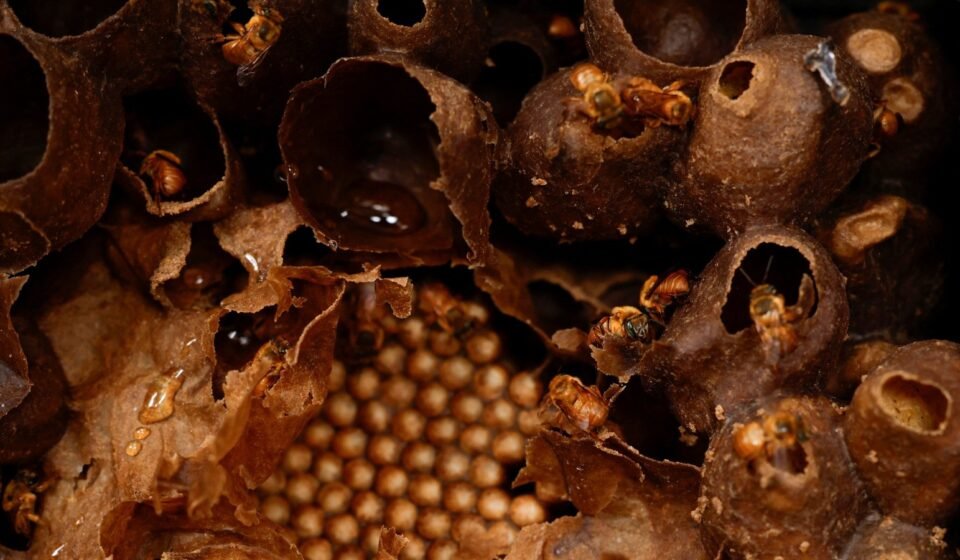

In a step described as unprecedented worldwide, stingless bee species in Peru have become the first insects to receive legal recognition of their rights. The change follows the adoption of the “Declaration of the Rights of Amazonian Stingless Bees” by a number of local municipalities, according to CNN Brasil. The development reflects the growth of the “rights of nature” movement, which seeks to give living creatures and ecosystems direct legal protection.
The declaration grants these insects rights that include the right to exist and thrive, to live in a healthy and sound environment, to be protected from the effects of pollution, climate change and human activities, and to have legal representation that allows their interests to be defended in court through environmental organizations and representatives of local communities. Although these small insects do not enjoy the fame of conventional honeybees, scientists stress that they play a central role in pollinating plants and sustaining ecosystems, especially in the Amazon rainforest.
A Campaign Rooted in Environmental and Indigenous Action
The declaration was adopted after a years-long campaign led by coalitions of environmental organizations, nature conservation groups and representatives of Indigenous peoples in the Amazon region. The effort sought to counter the accelerating decline in bee numbers caused by deforestation, the use of agricultural pesticides and the effects of climate change.
Peru is home to more than 175 species of stingless bees, out of more than 600 known worldwide. Although some of these species are tiny—some no longer than 5 millimeters—they play a vital role in pollinating plants and maintaining ecological balance in tropical forests.
Rosa Vásquez Espinoza, a researcher and chemical biologist who founded Amazon Research International, says her team found through research that began in 2020 that these native species are almost absent from Peru’s legislation. She said: “Stingless bees have the right to live and to access a healthy environment free of pollutants, pesticides and invasive species. These insects cannot defend themselves in court or confront the threats they face, but humans are capable of being a voice for those who have no voice.”
Part of a Broader Rights of Nature Movement
The initiative is part of a growing global trend that grants elements of nature independent legal status. In recent years, several ecosystems have received similar legal recognition, including Lake Mar Menor in Spain in 2022 and the Marañón River in Peru in 2024, which encouraged those behind the project to extend the concept to pollinating insects.
The declaration was drafted by a coalition that included Amazon Research International, the Earth Law Center, which specializes in environmental law, and Eco Ashaninka, which represents thousands of Indigenous people, as well as local bodies concerned with bee conservation and honey production. The regions of Satipo and Nauta adopted the declaration in October 2025 and January 2026 respectively, before other municipalities in the Cusco region later joined.
What the New Rights Mean
The new law allows environmental organizations and Ashaninka leaders to file lawsuits when bees or their natural habitats are harmed. Under this framework, certain practices—such as cutting down trees that contain protected bee nests or polluting the areas the insects rely on for feeding and reproduction—may be considered a violation of their legal rights.
Constanza Prieto Figelist, Latin America legal director at the Earth Law Center, sees the initiative as a meeting point between scientific knowledge and the traditional knowledge of Indigenous peoples. She said the process of preparing the legal text drew on the researchers’ expertise and the historical relationship linking Ashaninka communities to bees and forests, adding that the document “bridged the gap between science, Indigenous culture and local governance institutions.”
Bees at the Heart of Ashaninka Life
For the Ashaninka people, the role of stingless bees is not limited to preserving biodiversity. Local communities depend on the pollination services the bees provide to produce food and medicinal plants, and they use some types of their honey in traditional medicine practices. Supporters of the initiative argue that protecting the bees also helps support food security and the livelihoods of Indigenous communities living in the heart of the Amazon rainforest.
The Biggest Challenge: Implementation
Despite the declaration’s symbolic and legal significance, those behind it face the challenge of turning the texts into enforceable measures. Local authorities, working with environmental organizations and Ashaninka representatives, are developing regulations that set out how violations are monitored and penalized, including mechanisms for dealing with activities that destroy nesting sites or threaten bee habitats.
Espinoza hopes these regulations will be adopted this year, while Prieto Figelist stresses that building enforcement mechanisms represents “the first step” before considering expanding the experiment.
Growing International Interest
Peru’s experiment has drawn interest beyond the country’s borders. Supporters of the project have received inquiries from organizations in 14 countries across 6 continents that are studying the adoption of similar legal frameworks to protect their local bee species.
Although no case has yet been filed in court under the new law, authorities and local communities have begun taking practical steps. These include organizing workshops to raise awareness of the importance of stingless bees, expanding beekeeping activities, integrating the topic into educational curricula, and establishing local markets that support products from communities contributing to bee protection.
Supporters believe the initiative’s success will not be measured by the number of lawsuits, but by its ability to establish a new model for dealing with nature as a party deserving legal protection rather than merely a resource to be exploited. While the experiment is still in its early stages, it represents a global precedent that could open the door to granting more living creatures and ecosystems legal tools to defend their survival against growing human pressures.