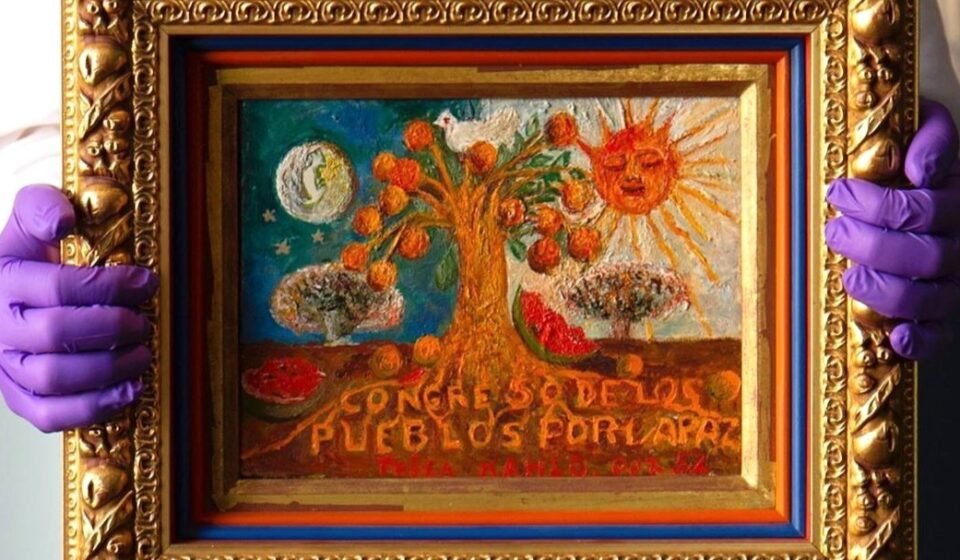

Christie’s pulled a Frida Kahlo painting from its New York auction on Tuesday, just hours before bidding was set to begin, acting at the request of the Mexican government. According to the French newspaper Le Figaro, the work—valued at up to $3.5 million—left the museum dedicated to the Mexican artist illegally and has been listed among missing works, as confirmed by Casa Azul, Kahlo’s Mexico City home that later became a museum bearing her name. The government asked the auction house to provide full information about the painting’s provenance.
The Painting and Its Symbolism
Titled Congreso de los pueblos por la Paz (Congress of Peoples for Peace), the canvas shows a dove perched on a fruit tree, surrounded by columns of smoke or explosions resembling mushroom clouds. In the foreground, a fruiting tree stands with a white dove flying above it as a symbol of peace. At the base of the tree, slices of watermelon are scattered—a recurring motif in Kahlo’s work that expresses vitality and Mexican identity. The artist created the piece for a peace congress held in Vienna in 1952, a direct reference to anxieties tied to the atomic revolution of the 1950s.
Christie's Statement
A Christie’s spokesperson told The New York Times that the auction house, in cooperation with the seller, decided to withdraw the painting from the 20th-Century Evening Sale “to conduct further research.”
Part of a Protected Trust
The painting was among thousands of items—including artworks, photographs, clothing, letters, and pre-Hispanic artifacts—that Diego Rivera, Kahlo’s husband, left as a trust to the Mexican people in 1955, one year after her death. The work is part of the Casa Azul museum’s holdings, and Rivera stipulated that the collection remain intact and never leave the site.
Dispute Over the Collection's Integrity
Hilda Trujillo, who served as director of the Casa Azul museum between 2009 and 2020, has claimed that a number of Kahlo’s works, including Congreso de los pueblos por la Paz, went missing during the decades before she took over the museum’s management. In a lengthy blog post published in April 2025, Trujillo said these missing items were discovered in the early 2010s during an inventory of the collection. She stated that she informed the Bank of Mexico, the entity responsible for administering the trust, but the bank took no action. Trujillo did not identify anyone she suspected of involvement in removing the pieces, and she declined to comment on the Christie’s auction in a text message.
The Bank of Mexico said in a statement issued at the time that Trujillo “was dismissed from her position due to violations whose nature it did not specify.” It added that she “did not file any formal complaint regarding mismanagement of the museum throughout her 18-year tenure,” a claim Trujillo denied.
The sudden decision to withdraw Kahlo’s painting from the auction comes amid questions about how serious the Mexican government is about preserving the legacy of the country’s most famous artist.