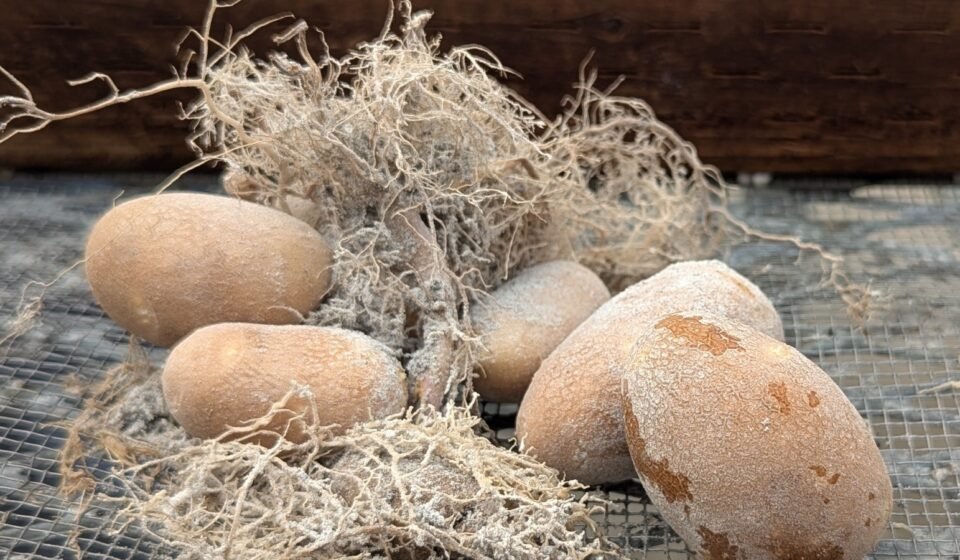

Researchers have found that potatoes can be grown in material designed to mimic the Moon’s surface, producing a crop comparable to those grown in ordinary agricultural soil in terms of growth, yield, and nutritional value. The advance could help pave the way for feeding astronauts and reducing reliance on supplies shipped from Earth.
According to a study by scientists at Oregon State University in the United States, supported by NASA, adding a proportion of organic matter to artificial lunar soil allows potato plants to complete their life cycle and produce edible tubers without a statistically significant rise in certain natural toxins that can accumulate in the crop.
The study, published in the journal npj Microgravity, reported that adding 30% vermicompost—organic fertilizer produced by earthworms as they break down organic waste—helped the plants achieve growth and development rates similar to those recorded in natural agricultural soil.
What the Researchers Found
“We found that potatoes can complete their full life cycle in soil that simulates lunar soil when it is supported with organic matter,” said co-author Aimerick Guihé, from the university’s Department of Botany and Plant Pathology.
He added that the results represent an important step toward developing reliable food production systems that could support long-term human exploration of the Moon.
The findings take on particular significance in light of NASA’s Artemis program, which aims to return humans to the lunar surface and develop a sustainable human presence. That goal requires finding ways to produce food locally rather than depending entirely on costly resupply missions from Earth.
Why Lunar Soil Is So Different from Earth Soil
The Moon’s surface differs greatly from Earth’s. Most of it is covered by a layer of crushed rock and fine dust known scientifically as regolith, which is almost devoid of the organic matter plants need to grow. This layer also contains concentrated levels of certain metals that can become harmful to plants, and it lacks the biological characteristics that define Earth’s soil, including microbial activity and organic matter decomposition cycles.
To test whether these obstacles could be overcome, the researchers used five types of material designed to simulate lunar soil, representing two major geological regions: the dark lunar plains known as the lunar maria, and the highland areas, which differ in mineral composition.
The researchers compared potato growth in these materials with growth in agricultural soil taken from Oregon’s Hermiston region, known for its high potato yields.
Results Across Different Organic Matter Levels
The experiments showed that plants grown in the artificial lunar soil without added organic matter suffered severe growth impairment, obvious stunting, and incomplete root development. Using proportions ranging from 5% to 15% vermicompost led to partial improvement, but when the fertilizer proportion was raised to 30%, the plants reached levels of growth, development, and productivity comparable to those grown in Earth soil. This suggests that lunar mineral materials could be converted into a productive growing medium after appropriate treatment.
The researchers believe the role of the organic fertilizer goes beyond supplying nutrients. It also extends to limiting the toxic effects of some metals present in the lunar soil simulants, helping organic matter bind to certain heavy metals and thereby reducing their availability to plants and their ability to harm roots or affect biological processes linked to growth.
“We believe the compost helps mitigate some of the toxicity associated with lunar soil by reducing the plants’ exposure to harmful compounds,” said co-author David Handy, a postdoctoral researcher in the university’s Department of Botany and Plant Pathology.
Nutritional Quality and Natural Toxins
The experiments included examining the nutritional properties of the resulting tubers to confirm that growing them in a lunar soil-like environment did not negatively affect their quality. The results showed that the potatoes retained their nutritional value, with no statistically significant increase recorded in glycoalkaloids—natural toxins found in potatoes whose levels can rise under certain conditions and which are sometimes associated with the green color that appears beneath the skin.
These findings indicate that a crop with acceptable nutritional characteristics can be produced in media that simulate lunar soil, although additional tests are needed to confirm its safety under actual farming conditions beyond Earth.
Recycling Organic Waste in Future Lunar Settlements
The researchers believe that making use of organic waste within future lunar settlements could offer a practical solution to the problem of transporting large quantities of fertilizer and agricultural materials from Earth. Astronauts could bring a limited initial amount of organic matter and then produce more by processing food scraps and plant waste and recycling them within closed systems.
This approach could help lower the costs of space missions, reduce waste, and improve the efficiency of resource use—factors essential to establishing human bases capable of operating for long periods far from Earth.
The scientists chose potatoes specifically for their ability to produce a relatively large number of calories per unit area, as well as for their nutritional value and potential to serve as a staple food during extended space missions.
What the Study Does Not Show
Nevertheless, the scope of the experiment makes clear that the results do not mean potatoes have actually been successfully grown on the Moon. The researchers used materials that simulate lunar soil within an Earth-based environment, not real samples grown under lunar gravity, radiation, and temperature conditions.